
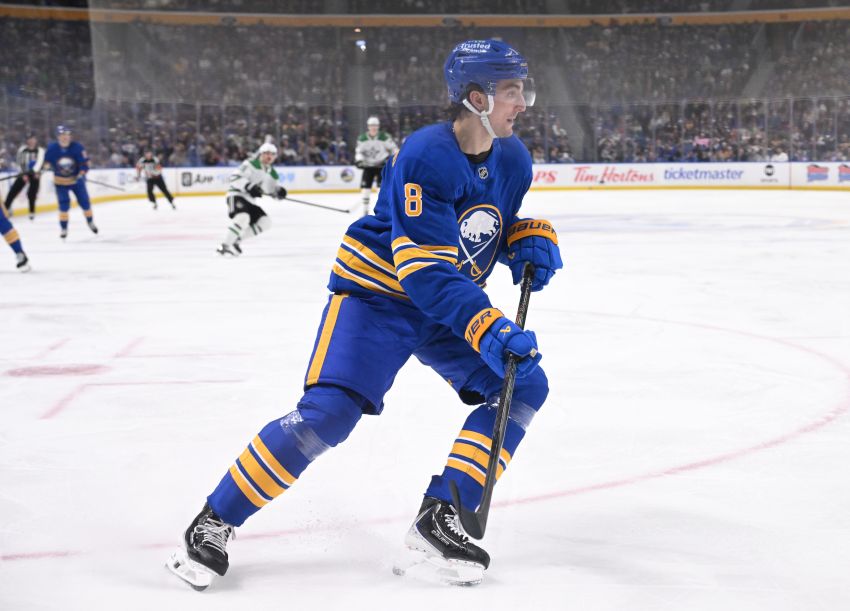
“Honestly, I think it’s been pretty good for me, and whenever the next opportunity comes, I’ll be probably the most ready I’ve been all year.” – Michael Kesselring on March 25 prior to sitting out his sixth straight game as a healthy scratch
BUFFALO – As he morphed into a spare part down the stretch, Sabres defenseman Michael Kesselring tried to make the most of a difficult situation.
If the arrival of defensemen Logan Stanley and Luke Schenn and the emergence of rookie Zach Metsa offered him a chance to work on his game and extra time to recover from the injuries that derailed his first season here, he would use it to his advantage.
Not that Kesselring, 26, was happy about sitting out. Just as he had started to find a groove, the Sabres beefed up their blue line before the trade deadline, pushing him out of the lineup.
That next opportunity never really materialized. Counting the Stanley Cup Playoffs, he played just three of the Sabres’ final 30 games, skating short minutes in two of those appearances.
Following a season that included a change at the top – Jarmo Kekalainen replaced Kevyn Adams as general manager – it’s fair to wonder what kind of future Kesselring, who can become a restricted free agent this summer – has with the Sabres.
“We believe in him still,” Sabres coach Lindy Ruff said last Wednesday in KeyBank Center.
Adams, of course, acquired Kesselring and winger Josh Doan 11 months ago in the trade that sent winger JJ Peterka to the Utah Mammoth.
In the 6-foot-5, 215-pound Kesselring, their prized offseason acquisition, the Sabres believed they possessed a right-shot defender to play alongside Owen Power.
Meanwhile, many viewed Doan, at least on the outside, as a secondary piece in the swap. He scored 25 goals and earned a seven-year, $48.65 million contract extension this season.
Kesselring, who said he had never been injured before this season, fell behind early and never caught up.
He hurt his knee in training camp as he tried to acclimate to a new team and missed the first nine games. After playing nine times, he suffered a high ankle sprain he later re-injured.
The American played just 34 games, muster zero goals and two assists. He scored seven goals and 29 points in 82 contests in 2024-25.
In their exit meeting last week, Ruff said Kesselring examined his trying campaign and said he had trouble handling the injuries.
“The fact that he had to start the year the way he started … I don’t think he skated well for the first half of the year, and we got into that second half where we had guys that were playing so well it was hard to make changes,” he said.
By the end, Ruff said Kesselring understood the difficult situation the glut of defensemen created. Ruff also said Kesselring “was really starting to skate well.”
Kekalainen said he recognized Kesselring was struggling during the season and chatted with him several times. He said sometimes he ran into Kesselring in the weight room long after everyone else had left.
“We have lots of belief in his ability,” Kekalainen said. “Great skater, big guy, right-handed defenseman. We’ve seen the potential that he has.”
Power, captain Rasmus Dahlin, Bowen Byram and Mattias Samuelsson are entrenched as the Sabres’ top defensemen.
Ruff and Kekalainen both explained how Kesselring must adapt if he’s cast as the fifth or sixth defenseman and given limited ice time. For example, he played just 4 minutes, 25 seconds on May 1 in his last appearance.
“Our top four is really, really good,” Kekalainen said. “If you come from a situation where you might’ve had top-four minutes before expecting to get top four minutes here, it’s tough competition. … You might have to adjust your style of play a little bit. You might have to just be the reliable five, six now instead of being a top four.
“I don’t blame any player for trying to be hungry for more, but first you have to fulfill the role that you’re in and be proud of it and then you can grow. And if the coaches decide that, ‘OK it’s time for him to grow to be a little bit more than we’ve given him,’ he’ll get it.”
Ruff said a fifth or sixth defenseman needs “to be a predictable player.”
“Predictable means going out doing the right things, and don’t hurt your team,” he said. “You don’t have to be an offensive guy, just be a good defenseman.”