
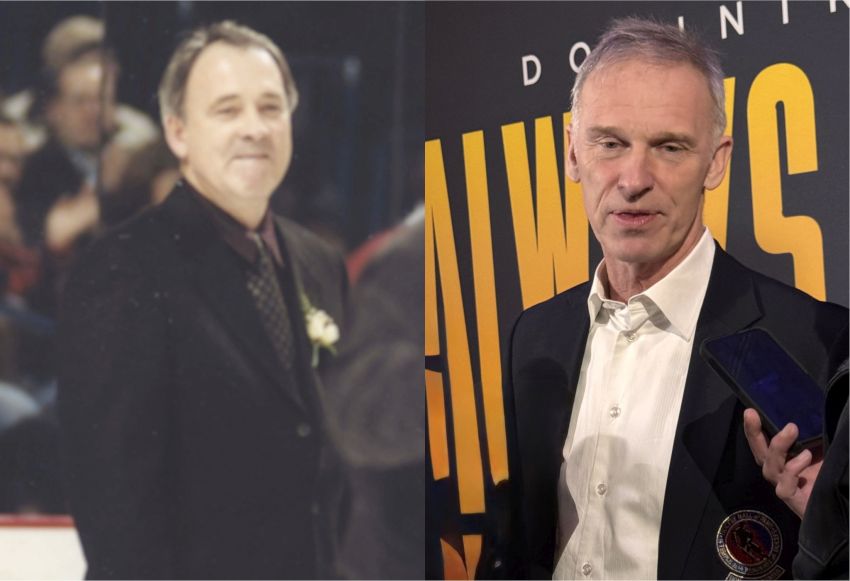
In 2022, as the 30th anniversary of the Dominik Hasek trade approached, I sat down with former Sabres general manager Gerry Meehan at a local golf course to discuss one of the most lopsided deals in NHL history.
How did it go down? When did the Czech first land on his radar? Could he have ever imagined Hasek would become perhaps the greatest goalie ever?
The trade, of course, was hardly a blockbuster at the time. Hasek possessed such an unorthodox style many believed he wouldn’t succeed in the NHL.
As you’ll read below, Meehan, who died Friday, first spotted Hasek in 1987, shortly after he took over as GM, at the World Championship in Austria.
Meehan wasn’t afraid to make bold moves, and while it took a little time, the Hasek trade paid handsome dividends and transformed the Sabres.
Gerry Meehan clicked on the YouTube link, and for a few minutes, as he watched some of Dominik Hasek’s early exploits, he was taken back to his first offseason as the Buffalo Sabres’ general manager.
It was 1987 and Meehan, having been promoted from assistant GM months earlier, needed to familiarize himself with European scouting. So he began scouring the continent for talent to improve a Sabres team that had just finished dead last.
On May 3, Meehan visited Vienna, Austria, to watch the Soviet Union and Czechoslovakia compete for the bronze medal at the World Championship. The Czechs’ goaltender that day was Hasek, a relatively unknown 22-year-old he had never seen play.
Hasek’s effort in his country’s 2-1 loss wowed Meehan. The youngster was the Czechs’ backbone, single-handedly keeping his overmatched teammates in the contest.
“It was an absolute territorial domination by the Red Army team,” Meehan said.
On Aug. 7, 1992, Meehan would bring Hasek to Buffalo, where he morphed from a seldom-used backup into “The Dominator,” a Sabres legend and perhaps the greatest goalie in NHL history.
Thirty years later, the trade remains one of the most lopsided ever. The genesis of Meehan’s deal can be traced to Hasek’s dazzling performance against the Soviets.
The key to goaltending, Meehan thought to himself after watching Hasek, isn’t goals-against average or won-loss record. No, it’s save percentage and what Meehan said is the “ability of the goalie to take on the responsibility of being the last man standing.”
“Two things happen in the NHL: you’re never going to have the best team every night and you’re never going to have the best outcomes from luck every night,” Meehan said. “But … if you can count on your goalie to make saves, you got a chance to win every game you’re, even if you’re outplayed or even if you’re having a bad night or even if your best players get hurt.
“And so recognizing that, I thought, ‘This is a guy who looks like he’s one of those goalies.’ So it just got stuck in the back of my mind.”
By 1992, following their fifth-consecutive first-round loss in the Stanley Cup Playoffs, Meehan knew he needed to upgrade the Sabres’ goaltending.
“We were a team in transition and going from being barely average to pretty good and pretty promising,” Meehan said.
Meehan coveted a goalie who possessed Hasek’s I’m going to stop every puck mentality.
Following the fall of the Iron Curtain, Hasek joined the Chicago Blackhawks, the team that had taken a flier on him in the 10th round of the 1983 NHL Draft. Still, he hardly made an impact, playing just 25 games over two seasons while backing up Ed Belfour, one of the league’s best.
Hasek, of course, was an unorthodox goalie, to put it mildly. He played aggressively, sometimes roaring out of his crease to the blue line to submarine an opposing player. He often dropped his stick to cover the puck with his blocker, an odd move no one else utilized.
His unique style created some hairy moments.
When Meehan rewatched some of that game in Vienna, he noticed those traits again right away.
“NHL coaches, generally speaking, are set in their ways, as anybody is,” Meehan said. “… And the coaches don’t necessarily take to them if they’re not formula goalies. And (an) unknown person, new guy from another country, I think in Chicago he just got stuck behind Belfour and didn’t get a chance to shine.”
Meehan had done the legwork and felt confident Hasek would at the very least give the Sabres a capable backup. He was available from the Blackhawks for the right price.
“And what we gave up was Christian Ruuttu indirectly,” Meehan said.
The Hasek deal, it’s often forgotten, took place in two parts. On June 15, 1992, the Sabres traded Ruuttu, a one-time all-star center, to the Winnipeg Jets in exchange for goalie Stephane Beauregard. Ruuttu had requested a trade during the previous season.
With the NHL Expansion Draft coming up, the Jets couldn’t protect Beauregard. Trading him allowed the Jets to essentially “stash” him.
“He was never intended to be on our roster at all,” Meehan said of Beauregard. “It was just basically a convenience to get the two key players – Ruuttu and Hasek – in each direction.”
Five days later at the NHL Draft, an excited Beauregard showed up at Buffalo’s table in the Montreal Forum and sat down next to Meehan.
“He came down and introduced himself,” Meehan said. “‘I’m here (he said), thanks, this is great, I’m looking forward to coming.’”
How awkward was that?
“Very,” Meehan said.
Finally, 53 days after the first trade, the Sabres sent Beauregard and future considerations to Chicago in exchange for Hasek. Three days later, the Blackhawks shipped Beauregard back to Winnipeg for Ruuttu.
Before Hasek’s arrival, Meehan’s penchant for making blockbuster acquisitions had rebuilt the Sabres into a team on the cusp of becoming a legitimate title contender.
In barely a two-year span, Meehan directed Alexander Mogilny’s defection from the Soviet Union, traded Phil Housley for Dale Hawerchuk in a deal featuring two future Hall of Famers and swapped Pierre Turgeon for Pat LaFontaine in a massive seven-player trade.
But at the time, acquiring Hasek wasn’t viewed as a significant move.
“I don’t think there was a lot of buzz,” Meehan said. “Most of the buzz was my own enthusiasm for him. I don’t think anybody in our staff or anybody in our scouting (department) were particularly hot on him, but that’s not to say they should’ve been, because they hadn’t done the kind of analysis that I had.
“My job was to decide, figure out how to have the best possible team, and it starts in the goal.”
On Oct. 8, 1992, Hasek played his first game for the Sabres, a 5-4 loss to the Quebec Nordiques on opening night at Memorial Auditorium. It would take time for Hasek to become a superstar. He did not pay immediate dividends. He spent much of his first season injured. Meehan even acquired goalie Grant Fuhr, another future Hall of Famer, later in the 1992-93 season.
When Fuhr suffered an injury early in the next year, Hasek took over the net, winning the first of his six Vezina Trophies. A legend was born.
“Would I predict that Hasek would end up being what he would be? No.” Meehan said. “But what I saw in him was this athletic, combative goaltender that didn’t play by the rules, and I’m convinced that’s why he never got a chance to play until basically somebody got hurt in front of him.”