
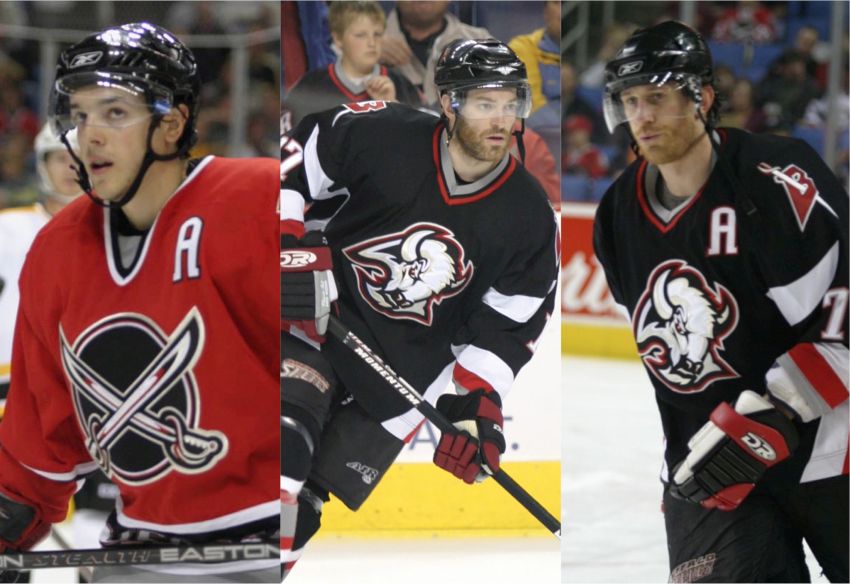
To a man, every member of the team walked out of HSBC Arena that night 20 years ago believing the Buffalo Sabres would win Game 7 and earn a trip to the Stanley Cup final.
Why wouldn’t players be confident? A tight-knit group that started the season with little or no expectations had come this far, taking the post-lockout NHL by storm.
When the Sabres began losing defensemen at a startling rate – three were injured by Game 6 of the Eastern Conference final on May 30, 2006 – the league’s best ensemble bent but never broke.
So after co-captain Daniel Briere scored in overtime to give the Sabres a 2-1 victory over the Carolina Hurricanes and force Game 7, it felt like destiny.
“We’re losing defenseman one by one each game that series, and we find a way to win,” former Sabres winger J.P. Dumont told the Times Herald. “And everybody was like, ‘Oh my God, boys, we got this.’ Now the pressure’s on them.”
Following the game, as raucous fans made so much noise the home dressing room shook, Sabres goalie Martin Biron said he noticed the special look in the eyes of coach Lindy Ruff, Briere and co-captain Chris Drury.
That told Biron they knew the Sabres would win Game 7.
Biron had seen that same look in Ruff’s eyes when the Sabres reached the final in 1999.
“It was no doubt we’re getting there after Game 6,” Biron told the Times Herald.
Biron had won gold medals playing alongside Briere for Team Canada at the World Junior Championship and World Championship. Drury had won the Cup with the Colorado Avalanche in 2001.
“Look, we had great leadership, right?” Biron said. “We had Chris Drury, who had won a Stanley Cup, who knew what it takes. You could see him after Game 6 in the locker room, and Dru wasn’t a vocal guy, but you could see it in his eyes, and he’s walking around like, ‘I’m going to have a chance to win a Cup again because we have that type of team to get it done.’”
Briere and Drury set the tone and established an inclusive culture. For example, Dumont said every player attended every team team function that season.
“That year, I’m not joking, everybody was there for everything,” he said. “It was amazing. It was amazing. It was something really special.”
The Sabres displayed their special bond on the ice. They possessed loads of confidence. Everyone contributed up and down the lineup.
“Everything was fitting,” Dumont said. “Everybody accepted their role. Everybody was playing. … Everybody was looking ahead like we’re all going to do this together, right?
“And every game, if you look back, every game was a different line, big goals by defensemen, right? It was not just one guy that had to do everything. This was what was so special for us.”
When the blue line started getting thin, the Sabres, who possessed depth everywhere but defense, turned to players they had utilized little during the regular season.
After Dmitri Kalinin suffered a season-ending ankle injury in Game 2 of their second-round upset of the Ottawa Senators, Rory Fitzpatrick moved into the lineup.
When Teppo Numminen suffered a hip flexor in Game 2 against Carolina, Doug Janik played his first NHL game in more than two years.
Henrik Tallinder broke his arm the next game, forcing Jeff Jillson, who had played two regular-season contests that year, into action.
Having lost half of their regular corps, the remaining regulars – Brian Campbell, Toni Lydman and Jay McKee – absorbed more minutes.
After skating 26 minutes, 19 seconds in Game 6, McKee said he “went home knowing in my heart we were winning the Stanley Cup.”
“It was just a moment I had,” he said on Jan. 15 when members of the 2005-06 team reunited for a 20th anniversary celebration. “I just had that feeling going to bed.”
The next day, a staph infection that became systemic forced McKee to be hospitalized. His teammates had no clue as they waited for him on the plane.
McKee usually played cards with Biron, Briere and Dumont during flights. When a trainer told them McKee was in the hospital, Dumont thought he was joking.
“When we saw the door shutting down, and it was like, ‘Oh man, this is serious,’” he said.
Still, the Sabres believed McKee could join them in Carolina.
“I’m like, ‘Where the hell is Jay?’” Biron said. “And they’re like, ‘He’s going to meet us in Carolina. He had to go get some stuff done at the hospital or whatever.’ And we’re like, ‘OK.’”
But McKee never made it.
Nathan Paetsch, who had played his first NHL game months earlier, was forced to replace McKee. The rookie had been rehabbing from a high ankle sprain he suffered with the Rochester Americans and hadn’t played in 62 days.
As much as McKee’s loss jolted the Sabres, Biron doesn’t believe it rattled them.
“You’re such in that mode at that moment, right, that you could lose 10 guys, you still think you’re going to win,” he said.
Of course, on June 1, 2006, the Sabres fell 4-2 in Game 7 after taking a 2-1 lead – Janik and forward Jochen Hecht scored late in the second period – into the third.
After Doug Weight tied the game 1:34 into the third period, Rod Brind’Amour’s power play goal following Campbell’s delay of game penalty put the Hurricanes up for good.
“We had that 2-1 lead, and … there was still a sense of belief in our structure, the way we were playing, that I don’t think we ever counted ourselves as underdogs or ever thought for one minute we weren’t going to win that series,” Janik told the Times Herald.
Twenty years later, the loss still stings. Maybe it doesn’t bother some guys every day, but they occasionally feel it.
After the Montreal Canadiens eliminated the Sabres in the second round of the playoffs last month, Ruff mentioned he wanted another crack at the Hurricanes in the conference final.
Blowing that lead in the third period still plays in winger Ales Kotalik’s head.
“I will always remember that third period that we lost in Carolina,” he said on Jan. 15. “We were told in the locker room that we have it all to win it, and it was so unfortunate, and biggest empty feeling that I felt when the game was over, that the chance is gone.”
If the Sabres had advanced, they would’ve faced the Edmonton Oilers, a team, on paper at least, they appeared more than capable of defeating.
Instead, the Hurricanes won a seven-game series over the Oilers to capture their first Stanley Cup.
Dumont felt cheated – “By the game, by the hockey gods,” he said – that night as he processed the injuries the Sabres endured and the bitter loss.
“I remember everybody looking at each other in the room, it was the feeling we came so close,” he said. “Now we know. If it happens again, we know what we’re going to have to do. But there was no regrets.”
Dumont never received another chance in Buffalo because the Sabres walked away from his arbitration award that summer. He signed with the Nashville Predators.
During the Sabres’ recent playoff run, when broadcasters mentioned a potential rematch with the Hurricanes in the conference final or their 2006 Cup win, Dumont said he groaned.
“It’s like a little pinch, right?” he said. “… That could’ve been the year for us.”
Meanwhile, McKee inked a big contract with the St. Louis Blues as a free agent that offseason.
He said missing Game 7 “will always wear at me, dig at me when it’s brought up or I think about it.”
“It’s a hard one because I believed in my heart we were winning,” he said. “Even with all the injuries we had, the room felt we were winning. But the sport has a funny way of picking or choosing bad bounces or injuries here or there. It’s an unfortunate one, but it’s really one that will stick with me forever.”