
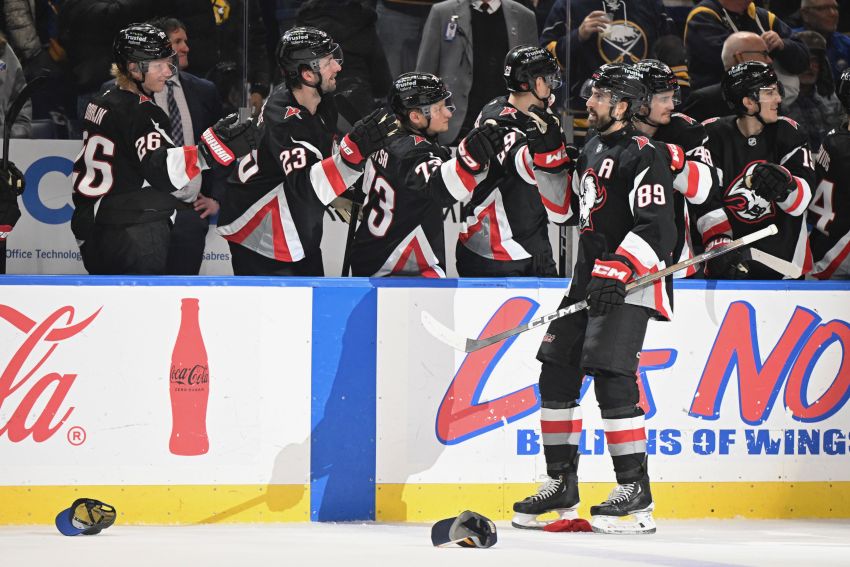
BUFFALO – Talent wasn’t the issue. The Sabres possessed loads of it.
To succeed, they needed to develop a harder, more mature style to complement a skilled roster. They needed to respond to adversity and showcase an identity night in and night out.
Well, for the last seven weeks, they’ve done all of that, joining the ranks of the NHL’s top teams during the stunning 20-3-1 run they carry into Saturday’s game against the Montreal Canadiens at KeyBank Center.
The Sabres, who have a five-game winning streak, have become a bear to play against. They attack in waves – their speed often overwhelms opponents – while receiving splendid goaltending and consistently limiting chances against.
Show of hands, who saw this coming?
Since early December, the Sabres have expected to win each game.”
“Stopped hoping,” Sabres winger Alex Tuch said after scoring a hat trick in Thursday’s 4-1 win over the Los Angeles Kings. “It’s good.
Through the struggles of past years and early this season, Tuch expressed his belief the Sabres, who own an NHL-record 14-year playoff drought, could win with this group.
“I thought we had the skill in the locker room to compete with anybody, but it was the will and determination that, I think, has really kicked up a couple notches that has given us a lot of confidence, just heightened everyone’s ability in here,” he said.
One of the most torrid runs in franchise history has ignited belief. Of course, given the Sabres’ recent history of losing, not everyone’s sold. They’ve teased in the past, enjoying some nice stretches before falling off again.
But the sample size this time, more than one-quarter of the season, is significant. The eye test – they’re regularly a step ahead of opponents and hold leads and grind out wins – illustrates luck has little or nothing to do with their success.
As hard as it might be to believe, the Sabres, who began Friday’s schedule in third place in the Atlantic Division, just five points behind the first-place Tampa Bay Lightning, could do some damage if they crack the postseason.
“We’re not here just to squeak in; we’re in here to try to keep winning,” Tuch said.
Early in the season, as the Sabres battled a slew of injuries and stumbled out of the gate, coach Lindy Ruff said he saw signs they would push through.
“We dealt with quite a bit of adversity early on,” he said. “That adversity made us stronger. Nothing came easy.”
Ruff said the Sabres kept talking about if they did the right things and believed in their play, they would be rewarded.
“I think they’ve seen that,” he said. “They understand.”
Ruff used Thursday’s third period as a prime example. After giving up 19 shots during the second period, they clamped down late, limiting the Kings to just seven shots.
“That’s winning hockey,” he said. “Don’t put a lot of risk in your game. And if you’re good enough at defending, it will be really hard for the other team to score a couple of goals.”
The Sabres now feel comfortable in those tense late-game situations.
“You’re up by a goal, you’re up by two goals, we’re not shaking in our boots, we’re trying to jam it right back down their throats, taking advantage of opportunities when we have to,” Tuch said. “We’re playing really good defense. … Our commitment to details and defense and defensive hockey has helped us become a top-10 team in the NHL.”
The development of their “B game” has also buoyed the Sabres and helped them remain competitive. During contests they don’t quite have it, they’ve found ways to break through by simplifying things and making strong decisions.
“If you’re not feeling yourself, or the team’s not maybe feeling it and making the nicest plays or anything, it’s just keeping it simple,” Tuch said. “It’s winning the small little battles. It’s being on the right side of the puck. It’s just playing smart. You see guys are really figuring it out, and it’s awesome.”
Ruff said puck management has boosted that “B game.”
“Not making things worse inside of a game,” he said. “(We’ve) probably shown a good deal of patience when you don’t quite have your legs, and (stayed) away from giving up real-high quality situations.”
Mr. Hoppe, how much, if any has the new GM, Jarmo Kekäläinen, affected this renaissance? (I had to google for the spelling of “Kekäläinen” and the spelling of “renaissance”).
I’m not sure. Let’s no forget the streak started when Kevyn Adams was still GM.